In the development of photovoltaic projects, the selection of the ballasted PV mounting system that directly affects construction efficiency, project costs and long-term operation stability is of great importance.
As a mature and widely used solution, the ballasted pv mounting system which is especially suitable for flat roofs, open ground and geological conditions with difficult piling is quite appropriate.Its core characteristic lies in that it doesn't have to penetrate the roof or the ground structure; rather, it simply depends on its own weight to fix the photovoltaic modules and resist wind loads and other external forces.
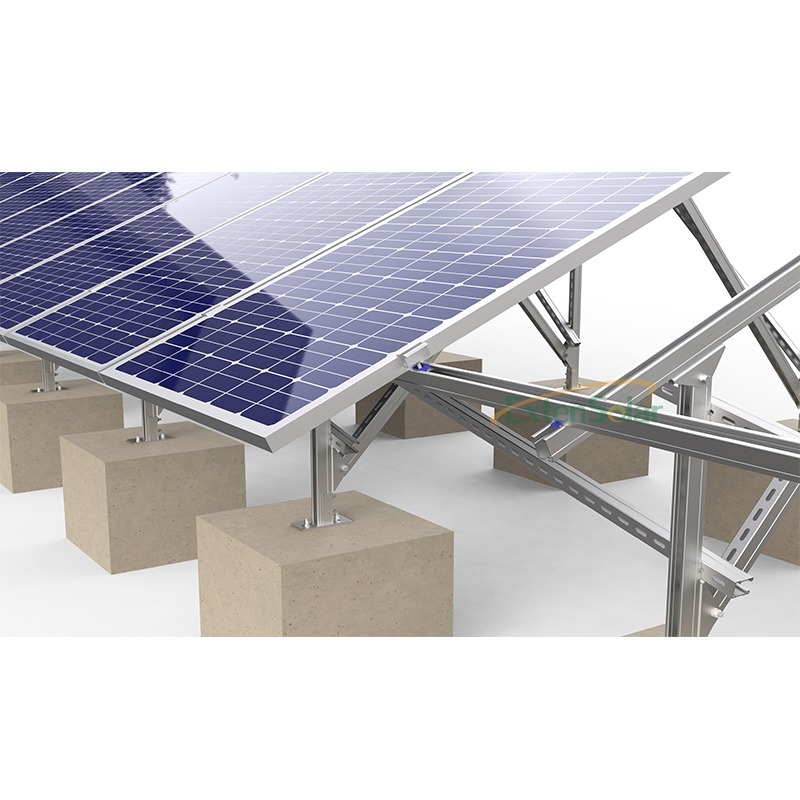
The basic configuration of the ballasted pv mounting system is relatively simple, usually including a supporting structure, a track system, and ballast blocks which can be precast concrete blocks, metal boxes filled with materials, or even other heavy objects found on the site.The ballast blocks are placed precisely on the installation base, and gravity is used to provide the resistance for preventing sliding and overturning.When designing the ballasted pv mounting system, engineers need to carefully calculate the stability factors under wind loads, snow loads and seismic forces, so as to ensure that the system can be safe even in extreme weather conditions.
For large - scale commercial or industrial rooftops, there are considerable advantages in the ballasted pv mounting system. Firstly, it doesn't penetrate the existing roof, thereby causing no damage to the roof at all.The traditional installation method which typically includes drilling holes on the roof and installing expansion bolts not only can extend the construction period but also can raise the risk of leakage.On the contrary, the ballasted pv mounting system that does not need to penetrate the waterproof coating at all is simply to place the ballast blocks evenly on the roof structure. This greatly reduces the long-term maintenance costs and also keeps the roof's warranty still valid.
Secondly, the ballasted pv mounting system is installed quite rapidly. Since there is no need for complicated fastening procedures, the construction team can pre-assemble most of the installation frames in the factory in advance; the on-site work is only positioning the frames according to the design drawings and also placing ballast blocks and so forth.A team with a high level of skill that has four members can install hundreds of modules each day.In large - scale ground grid - connected power station projects, the application of ballasted pv mounting systems can also avoid a large quantity of earthwork and concrete foundation pouring, thus directly and greatly shortening the entire construction period.
In terms of material costs, the ballasted pv mounting system is also quite competitive. Although ballast blocks will bring about some material costs, those that do not require piling equipment can save a large amount of labor costs.For the sites that have complex geological conditions, for example, the areas where there are dense underground pipelines, the places that have the landfill cover, or the sites that are above the existing parking lots, the photovoltaic installation system which is based on ballast is practically almost the only feasible option.It doesn't need to dig deeply into the ground, thereby ensuring the minimum interference to the existing site.
In terms of environmental adaptability, the photovoltaic installation system based on ballast that shows relatively high flexibility can adjust the weight and distribution of ballast blocks in order to adapt to roofs of different inclinations so as to really meet the design requirements. For roofs having a slope of 5 degrees or less, the standard ballasted-based photovoltaic installation system can be directly used. What would happen if the slope exceeds 10 degrees then the enhanced design with anti-slip mats or additional side blocks can be adopted. Also in the coastal areas with high wind speeds to make the ballasted pv mounting system more stable as a whole one can also increase the weight of ballast blocks or use streamlined brackets to reduce wind resistance in this way.
Maintenance and future expansion that are also key advantages of the ballast - based photovoltaic installation system. As this system does not rely on fixed foundations, components can be easily removed and reinstalled when there is a need to replace or adjust the array layout.For photovoltaic projects in stages, once the first stage is completed with the ballast-based system, the subsequent expansion is simply installing new ballast bases in adjacent areas without having to carry out destructive alterations to the existing system.This function is much liked by large real estate owners and investors.
Certainly each technology has its own limitations. The photovoltaic installation system that is based on ballasts will bring about certain requirements for the load - bearing capacity of the roof.Before installation, a structural engineer needs to carry out a detailed load analysis on the roof so as to make sure that the existing structure can support the combined weight of the photovoltaic system and the ballast blocks.As for the relatively old roofs or the roofs with insufficient bearing capacity, reinforcement may be required or other lightweight methods need to be considered. Moreover, when the ballasted pv mounting system is used on steep sloped roofs, it is somewhat restricted; at this time, the mechanical-fixed installation structure is more recommended.
In order to help industrial users better apply the ballasted pv mounting system, the standardized design software and selection tools have become quite complicated. Users only need to input the meteorological parameters of the project location, the roof type and the component size, and the system will automatically calculate the required ballast weight and the installation layout.This digital workflow, which has significantly reduced the design threshold, also lessens the risk of human calculation errors.
Generally speaking the ballasted pv mounting system that is based on ballasts is a reliable cost effective and environmentally friendly installation solution they are especially suitable for flat roofs soft foundations and application scenarios where the existing site needs to be retained.As the number of distributed photovoltaic projects keeps on increasing, the photovoltaic installation system based on ballasts that is quick to install, has little impact on roofs, and is highly flexible is becoming a solution that more and more project developers are preferring.If you are planning a photovoltaic project that doesn't need to penetrate the ground, then the ballasted pv mounting system is quite worthy for you to carefully consider.


